
Ghost Wolves
What is a ghost wolf?
Ghost wolves are unique wild canids found along the Gulf Coast of Texas and Louisiana that carry genetic ancestry from the endangered Red wolf (Canis rufus). Although Red wolves were declared extinct in the wild in 1980, some of their genetic diversity survived through historical interbreeding with coyotes. Today, these coastal canids preserve portions of the Red wolf genome, including genetic variation that may no longer exist in the surviving captive breeding population of Red wolves.
The name “ghost wolf” reflects this remarkable genetic legacy: traces of a nearly lost species persist in the DNA of animals living in our coastal communities.
What makes ghost wolves genetically remarkable is that they preserve Red wolf ancestry and genetic variants that may be absent from today's surviving Red wolves. All of today's Red wolves descends from a small number of founders, representing only a fraction of the species' historical genetic diversity. Ghost wolves provide a potential reservoir of ancestral variation that was not captured when the captive breeding population was established.
This genetic diversity is important because it could help conservation efforts:
-
Recover lost genetic variation: Identify and potentially restore red wolf alleles that are missing from the current breeding population.
-
Expand the genetic foundation of recovery: Introduce additional ancestral diversity into a population descended from very few founders.
-
Support long-term conservation: Investigate whether recovered genetic variation could help reduce the consequences of inbreeding and improve the evolutionary potential of future red wolf populations.
Ghost wolves are not a separate recognized species, nor are they simply Red wolves. They are canines of mixed genetic ancestry whose genomes preserve an important part of the Red wolf's evolutionary history.
Ghost wolves represent more than a genetic connection to the past. They offer a potential pathway to restoring biodiversity once thought permanently lost.


The Discovery That Changed the Story of the Red Wolf

An unexpected discovery on Galveston Island, Texas, revealed that part of the Red wolf's genetic legacy had survived in the wild, hidden within a population of coyotes.
The story began with Galveston resident and wildlife biologist Ron Wooten, who noticed something unusual about the wild canines living on Galveston Island. Through his observations and photographs, Ron recognized that some of these animals had physical characteristics resembling Red wolves, a species that had disappeared from the region decades earlier.
Rather than dismissing these animals as ordinary coyotes, Ron sought scientific answers. He contacted researchers and ultimately connected with me, Dr. Bridgett vonHoldt (an evolutionary geneticist at Princeton University). He provided photographs and tissue samples collected from two animals killed on local roads, allowing my research team (which included post-doctoral scholar Dr. Kristin Brzeski and graduate student Liz Heppenheimer) to investigate their genetic ancestry.
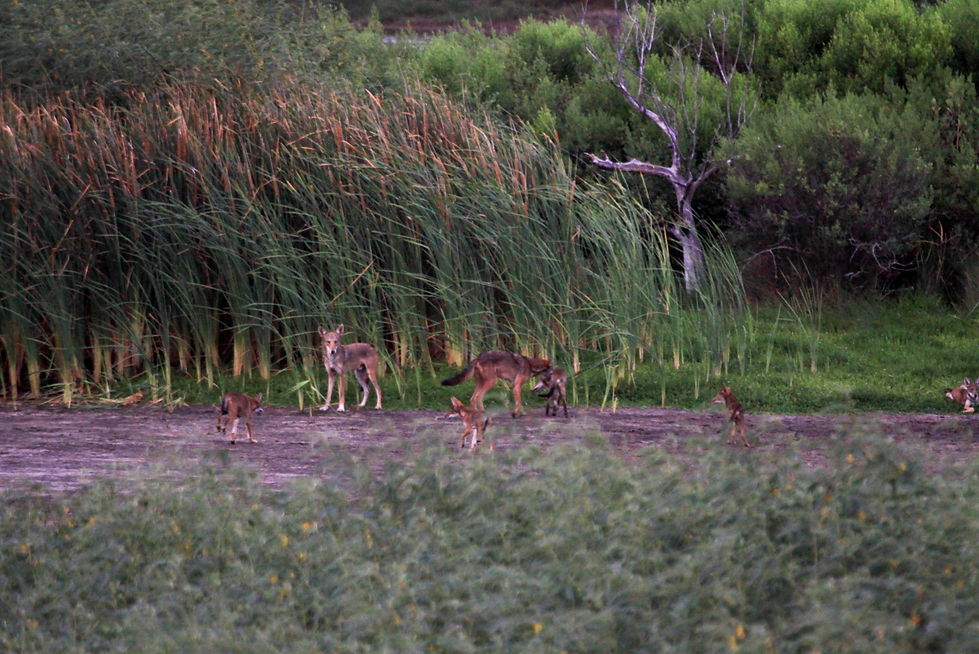
The original photo of ghost wolves on Galveston Island that ignited their discovery. Photo credit: Ron Wooten
The results were remarkable.
Using genomic data, we compared the Galveston animals with coyotes, gray wolves, eastern wolves, and endangered Red wolves of the captive breeding program. We discovered that the Galveston coyotes carried substantial Red wolf genetic ancestry, including genetic variants shared with Red wolves but not detected in the other reference populations.
Even more intriguing, the animals carried genetic variants that were absent from the reference populations, raising the possibility that some ancestral {pre-extinction} Red wolf diversity had survived outside the endangered species' established conservation breeding program.
In December 2018, we published these findings in the scientific journal Genes, documenting the rediscovery of Red wolf genetic ancestry along the Gulf Coast.
This discovery challenged the assumption that the Red wolf's disappearance from the region meant that its genetic legacy had vanished completely. Instead, historical interbreeding with coyotes had allowed portions of that ancestry to persist across generations.
What began with a local resident's curiosity became a scientific discovery with important implications for the future of Red wolf conservation.
Today, tour team continues to build upon this discovery by investigating the genetics, ecology, and conservation potential of these remarkable animals.
The story of ghost wolves reminds us that biodiversity can persist in unexpected places, and that scientific discoveries sometimes begin with someone simply paying attention to the wildlife around them.
Coyotes Matter
Coyotes (Canis latrans) are often misunderstood, particularly in regions where they are considered common or abundant. Yet their evolutionary flexibility and ability to survive in changing landscapes have made them unexpected guardians of endangered genetic diversity.
Through historical interbreeding, coyotes inherited portions of the Red wolf genome and passed them in their pups over subsequent generations. Some of these genetic variants may no longer exist in the Red wolf captive breeding program.
This discovery challenges a traditional view of hybridization as exclusively a threat to endangered species. Under some circumstances, hybridization can also preserve genetic variation that would otherwise be lost.
Without coyotes, some of the Red wolf's genetic legacy might have disappeared entirely.

Cloning Hope: Neka Kayda and the Future of Ghost Wolf Conservation
Our group is helping pioneer a new approach to endangered species conservation through a collaboration with Colossal Biosciences and their non-profit Foundation. Together, we are combining population genomics, reproductive biotechnology, and wildlife conservation to recover genetic diversity once thought lost from the endangered American red wolf.
A major milestone in this effort was the birth of Neka Kayda in 2024, the first cloned ghost wolf. Her name, meaning "Ghost Daughter," was given by the Karankawa people of the Texas Gulf Coast tribe, honoring the cultural and ecological connections between wolves, Indigenous communities, and the region's natural heritage.
Neka Kayda was cloned from a wild female ghost wolf discovered in Cameron Parish, Louisiana. Our genomic analysis revealed that Neka Kayda's wild donor carried approximately 70% Red wolf ancestry and several hundred ghost alleles. It is these ghost alleles that are associated with the ancestral Red wolf lineage that are currently absent from today's Red wolf captive breeding program and hence excluded from the genetic definition of a Red wolf. Her exceptional genetic ancestry made her a valuable candidate for conservation cloning.
Using advanced reproductive technologies, Colossal successfully produced Neka Kayda and three additional cloned male ghost wolves, Ash, Blaze, and Cinder. These animals represent an important first step toward preserving rare genetic lineages that might otherwise disappear.

Karankawa and Colossal Foundation Executive Director Matt James (center, holding Neka Kayda) at the ceremony establishing our first cloned ghost wolf as both culturally and scientifically significant.
Why Ghost Genetics Matter
Today's Red wolf population descends from just 12 genetically represented founders, creating a severe limitation on the genetic diversity available for recovery. However, our research has demonstrated that some wild Gulf Coast canids retain substantial Red wolf ancestry, including genetic variation inherited from historical populations.
These discoveries challenge the traditional assumption that hybridization necessarily diminishes conservation value. Instead, ghost wolves demonstrate how genetic ancestry can persist through generations of admixture, preserving an evolutionary legacy even after a species has disappeared from much of its historical range.
By identifying and preserving these genetic lineages, we have an opportunity to expand the genetic resources available for Red wolf conservation.
Conservation Impact: From Discovery to Genetic Rescue
The cloning of Neka Kayda represents more than a technological achievement. It establishes a new pathway for conserving genetic variation that cannot be recovered from the existing Red wolf breeding program alone.
Our long-term goals include preserving rare ancestral Red wolf alleles, establishing genetically diverse conservation breeding lineages, evaluating opportunities for carefully managed genetic rescue, and supporting the eventual restoration of Red wolves to suitable habitats within their historical Gulf Coast range.
Cloning alone does not increase genetic diversity or restore a species. Its conservation value lies in preserving distinct, genetically valuable individuals whose descendants could contribute previously unavailable variation to future breeding and recovery programs. Achieving these goals will require continued genomic research, careful breeding management, ecological assessment, and coordination with established red wolf recovery efforts.
Neka Kayda represents a shift in what conservation may be able to accomplish: moving beyond protecting the genetic diversity that remains toward recovering evolutionary variation previously believed to be lost.
Through this partnership, we are helping demonstrate how scientific discovery, community engagement, and emerging biotechnology can work together to create new opportunities for endangered species recovery when conventional methods have reached their limit.


